

Objective
To provide farmers and agricultural businesses with access to specialist climate and weather information to support agricultural decision-making and strengthen their capacity to adapt to climate risks.
Description
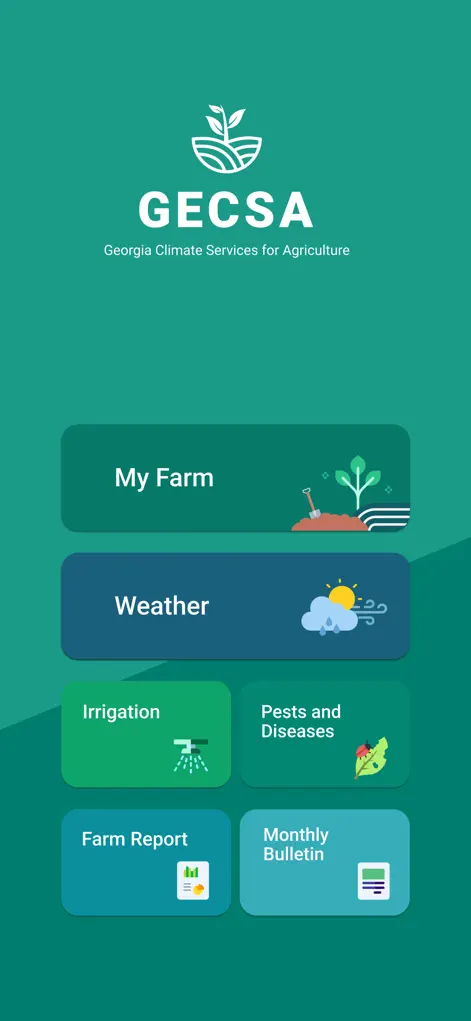
The Georgian Climate Services for Agriculture (GECSA) is a web- and mobile-accessible agrometeorological platform that provides farmers with climate and weather information services. It operates within the areas of climate change adaptation, climate services, agricultural risk management, and early warning systems. GECSA is part of the larger Multi-Hazard Early Warning System project, funded by the Green Climate Fund (GCF), Switzerland, Sweden, and the Government of Georgia. Its goal is to provide farmers and agricultural businesses with access to specialized climate and weather information products to support agricultural decision-making. Key activities include expanding the agrometeorological observation network, improving monitoring equipment and technical capacity, developing and delivering climate and weather information services, creating agroclimatic maps, calendars, and advisory products, as well as farmer training and climate awareness activities. The stakeholders involved are the Rural Development Agency (RDA), the National Environmental Agency (NEA), the National Food Agency, the Scientific-Research Centre of Agriculture, the Georgian Farmers' Association, and Seoul National University. The platform provides short- and long-term weather forecasts, climate risk assessments, early warnings for pests and diseases, and irrigation management support. The pilot project was implemented in the Kakheti and Shida Kartli regions before being expanded to Kvemo Kartli. The main crops involved are apples, grapes, peaches and nectarines, wheat, and maize. More than 1,000 farmers are registered in the system. The platform processes data from agrometeorological stations and provides forecasts, alerts, climate risk information, and agricultural recommendations via a web and mobile application.
Country
Georgia
Ladder
National → Local
Nature
Non-financial
In which law/program is this instrument included?
Digital agrometeorological platform
Implementation of GECSA
Fieldwork indicates that GECSA was developed as an agrometeorological component of a larger climate change adaptation and early warning system project. Interviews suggest that, while climate services for agriculture were considered from the outset of the project, the specific services provided by the platform were defined progressively during implementation through collaboration among government agencies, researchers, and farmer representatives. Interviewees also emphasized the importance of the pilot implementation, consultations with farmers, and agricultural extension services in shaping the final platform design.

Source: UN Georgia | Photo credit: © RCO / Gela Bedianashvili


Farmers in the Kakheti and Shida Kartli regions are being trained in the use of GECSA, an agricultural application that promotes sustainable and climate-resilient agriculture. Source/Photo credit: UNDP Rural Development Agency in Georgia
Chronology of the instrument
The Directory of Researchers of the Instrument
-

Ninaka Berdzenishvili
Fieldwork in Georgia and the United Kingdom (WP2 & WP3) | PhD Candidate, Paul-Valéry University Montpellier 3 / CIRAD
-

Nikoloz Kachakhidze
Fieldwork in Georgia | Research Intern, CIRAD | Master's Student, Caucasus University


Library and Documents
